Let me try to simplify this discussion, at least from the hardware side.
This is the factory I5 transmission. It is NOT the standard chevy pattern that has been used for the last 40 years, it is an atlas engine specific pattern.

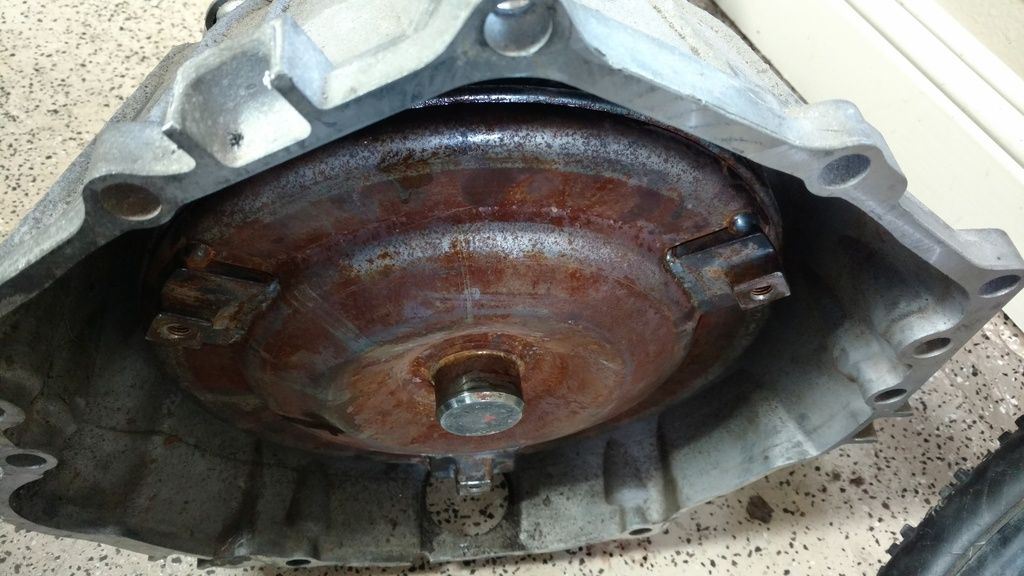
If you notice the starter is at the 2'oclock position on the drivers side. Also note the torque converter, it is the smaller 245mm converter and it has a narrow pointed pilot made to fit the atlas engine crank.
This is the same transmission but fitted with the older style standard chevy bellhousing. Note the starter is at the 8'oclock position. Note also this is a 298mm torque converter which is a bit larger. Notice the snout on the torque converter, it is 1.70" diameter and stubby to fit small block chevy or LT engine cranks.

The pattern for LS engines is identical, however the distance from the bellhousing face is a little different and the top spot of the bellhousing has an additional bolt hole. Here is a 6L80e and you can see the similarities
So lets backtrack. The reason the factory I5 transmission needs modification when going from I5 to V8 is because the bellhousing pattern is different. In addition, the pilot dimensions on the torque converter won't match either so that has to be changed as well. All of the LS style torque converters are built for a 30 spline input shaft on the transmission. The I5 torque converter is matched to a 27 spline input. So when swapping out from I5 to v8, at a minimum the bellhousing, torque converter and input shaft all have to be changed to allow it to bolt up to an LS engine. The 6L80e by comparison already has an LS compatible bellhousing and torque converter so no modifications are needed to bolt it to an LS engine.
Now going the other way, trying to bolt a 6L80e to an I5 also is not directly compatible. Looking at the back of the i5 makes it very obvious.

The pattern is completely different, the starter is on the wrong side, plus the torque converter snout doesn't match the crank. The solution to this would be to bolt on an adapter plate to the back of the engine to provide the correct interface. This is not as simple as it sounds, the first point would look to be that the starter needs to go right where the exhaust is. Second, not only does the transmission pattern need to match, things like torque converter depth in relation to the bell face plus pilot snout dimensions must all also match. I cannot comment on the availability of these adapters, but from some above links, it seems like at least one or two have attempted it.
Now on to the output side. The 4L60e has a 27 spline output shaft. The 4L80e and the 6L80e both run a larger dimension 32 spline output. This is what the factory transmission looks like at the rear.

To adapt the transfer case two routes can be taken. 1) match the transfer case input to the transmission output, or 2) match the transmission output to the transfer case input. For our case as explained in earlier posts in this thread, there is no available 32 spline input available for the borg warner transfer case, and even further, there is not even enough material in the factory transfer case input to bore it out to 32 spline. This leaves only one option for running the factory transfer case, cut the transmission output shaft down to a 27 spline.
This is not a major undertaking for a competent shop, HOWEVER, the output shaft is the first part that is assembled in the case. So that means to get the output shaft out to machine it, the entire transmission must be disassembled to get to it. So even if you score a low mileage perfectly good transmission, you still have to tear it all the way down to swap parts into it.
That should cover the mechanical side, I'll let others comment on the electrical side. As a side note, the tech is now there to run a 6L80e standalone. Thats the path I am about to dive head first into behind a diesel.


