• Welcome to H4O! For a reduced ad experience, please login or register with the forum.

S.A. Upgrade...How to make your own HP-passenger side D44...

4speedfunk

Well-Known Member
Messages
4,250
Location
Tardville
Well...as usual I got another Frankenstein project going on. Thought I would share this with some of the SA and IFS guys.

I've been running a solid front axle for nearly a year now. Its a stock-width, GM low-pinion, Dana44 and I'm tickled with how well it works. But, I'm always interested in perfecting my rig, so I thought I would play around with making my own high-pinion version of the same housing. Those in the know realize that no such critter exists. The basic issue is that the H3 needs an axle with the pumpkin on the passenger-side. The only high-pinion Dana's came in Fords...and they have the pumpkin on the drivers-side. So I grabbed a Ford HP Dana from my bottom-less pile of axles and went to work.

First step was to knock out the inner axle seals, and torch-off the tubes about 2" from the casting. This would give me some tube to grab on to during the "extraction" process. The second step was to remove the factory rosette welds to release the tube from the casting. After trying hand-drills, a drill-press, and alot of profanities....I resulted to using my favorite tool, Mr. Plasma-cutter (sorry I ever doubted you). The plasma made short order of blowing the weld out of the (12) 1/2" rosette holes. Next I needed to find a way to cut the tube along its length, so I could collapse it and pull it free. Once again...Mr. Plasma did the trick. I cut from the inside of the tube and I had to be careful to not cut into the casting. After-all...I want to save the casting for re-use.

Once I started cutting, I realized that the plasma-cutter loves to cut steel (the tubes) with ease...but seems to have difficulties cutting ductile iron (the casting). This is great because it saved me the worry of gouging the casting by accident. Still I used caution and made sure to only cut deep enough to slice the tube. After a couple slices...I was able to collapse the tubes in a vise and they pulled right out.

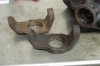
Next I went on to the inner C's. These were robbed from the same 10-bolt I cut up last month (for the failed IFS pumpkin). I simply ground them down until I saw the parting line. Then I sliced the tubes lengthwise in two places with a saw-zall...and "plink". The tubes came right out. The photos below show where I'm at right now....clean Ford HP chunk, and clean GM inner C's...

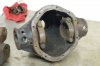
HP-D44-3.JPGHP-D44-1.JPGHP-D44-2.JPG

Rather than try to remove some tubes from another axle (hard to do without screwing them up)...I have ordered some new virgin DOM tubing. Size is 3"O.D. x .500" wall thickness (slightly thicker than stock). I will update this thread as I get further along with this build. The end result is a front axle that is alleged to be 15% stronger, and also has more ground clearance. Additionally, it allows for a straighter driveshaft angle and because I will be welding my inner-Cs on...I can position them for optimum castor angle without sacrificing pinion angle.

This will be assembled to stock GM housing width, and thus use standard-length axle shafts.
 

06 H3

a.k.a. "The Jackal"
Messages
9,499
Location
Meridian, ID
Wow! That's awesome. Your getting as custom as you can get. Will you be doing the rosette welds and Inner C welds or are leaving that to the Thor parts production welders?

Will the shafts be custom or still use the ford shafts? I'm sure you could use them right? Just be used on opposite sides seeing your swapping it from d drop to p drop or will the length of the tube change for matching width?
 
Last edited:

4speedfunk

Well-Known Member
Messages
4,250
Location
Tardville
No...I will not attempt welding this myself. I know several guys that are qualified, and I'll leave it up to them. The casting will need to be pre-heated prior to welding and special rod (made for cast iron) will be used. I read on pirate about "peening" and "heat-treating" after welding but, I'm not convinced any of that is necessary. If you need that kind of strength...just buy a Dynatrac pro-rock, (it would be cheaper). The whole point of doing this is: its made of junkyard parts, and the everyday guy can do it in a weekend for less than $500.

No Dodge parts in this. I'll use stock length shafts for the GM application....same shafts as the plain ole low-pinion housing. Lots to choose from: Spicer, Superior, USA, Yukon, RCV, etc. The key is...they will be stock, so no custom cut or mix-matched applications will be needed. I could run stock used GM shafts but, I'll probably pop for some chro-mo ones. I've been told by several sources that shafts are by far the weakest link in the D44.
 

06 H3

a.k.a. "The Jackal"
Messages
9,499
Location
Meridian, ID
Whoops meant ford because its a ford housing. A GM carrier will fit in a ford housing? Guess there exact same size D44
 

jakesz28

Well-Known Member
Messages
1,056
Location
Cabool MO
I bet I have broke at least 6 or 7 of the stock 44 axles in my last truck. This is going to be interesting.


I also do not believe that it is cast iron. It is a cast steel. Which opens up what rod can be used. When I worked in the foundry we ran many different types of cast steel and most where repaired with a mig welder if there was casting flaws. But I can't remember the wire being used.
 
Last edited:

4speedfunk

Well-Known Member
Messages
4,250
Location
Tardville
Jake...you may be right on the cast iron vs. steel thang. I simply don't know enough about metalurgy (apparently I can't even spell it correctly), to make a determination. I know some serious welders, (guys with nuclear certs that weld for NASA). I'm just gonna tack it at the proper angles, and drop it off for them to final weld.

If you look at how the whole thing gets assembled at the factory, you'll realize that the tubes are NOT actually welded to the pumpkin. Instead they are pressed into the pumpkin (a very tight fit)...then the rosette welds are added to the tubes to sort of "pin" them into place. There are six 1/2" holes spaced evenly around the circumference of the casting, where each tube plugs in. These holes get filled with "puddles of weld". The weld isn't intended to actually fuse the casting to the tube...but rather to fuse the rosette puddles to the tube. The fact that the puddle resides inside a 1/2" hole in the casting, is what "pins" the tube in place. IMO...any fusing that happens between the casting and the tube, is strictly incidental and not intentional. I think the real weld is between the puddle and the tube. It just happens to puddle-up, spill out, and bond onto the sides of the holes. Think of the holes as a concrete form...it just sort of "contains" the puddle of weld. The real intentional fusing occurs at the bottom of the puddle...to the steel tube. Given this discovery and assessment, (if I'm correct)...I'm not sure you even need any special rod. Simply press the tubes in and then fill the 1/2" holes up with weld. Just like the factory...you're welding to the steel tube at the bottom, and not to the casting. After cutting this one apart...I'm fairly certain this was the intended idea behind the rosettes.

Of course many axle guys (including me) will go ahead and do a full-circumference weld where the tubes join the casting. This is probably overkill but its extra insurance against loose tubes and also prevents leaks. This weld would obviously require pre-heating the casting, using a high-nickel rod, and mega amperage...so I'll leave that up to the pros.

BTW...if you look at the photos on the original post, the two large holes in the rear face of the casting are for alignment dowels. These do not get welds...they are there to properly clamp the casting to a bench and align it for machining.
 

4speedfunk

Well-Known Member
Messages
4,250
Location
Tardville
I'm currently running a stock low-pinion GM housing, and the caster is set at 5 degrees. It steers well, and the wheel returns to center by itself...no death wobbles or anything wierd, so I think I'm definitely in the ballpark. Of course the pinion angle is probably about 4 or 5 degrees away from optimum. I haven't checked the actual pinion angle at the yoke...but I'm guessing its around 10 or 12 degrees. It doesn't vibrate however and the front driveshaft angle looks very much the way any GM truck from the 70s or 80s looks. So...a BONE STOCK GM HOUSING works just fine as long as you keep your lift around 6"-7". Any more than that...and you should cut-off the C's and rotate them to correct for the lift.

Since I'll be swapping to a high-pinion, at first glance it looks like I can weld it up very similar to the stock low-pinion housing angles. This is because the yoke gets moved upward a good 3"-4", and that would put the front driveshaft angle just about perfect. I'll be taking a closer look at this issue after I get the tubes installed. Welding the C's will be the last thing I do. I'm doing some research on large tires vs. pinion angle...not real sure what number I should shoot for. I know 5 degrees works but, would 8 work better?
 

4speedfunk

Well-Known Member
Messages
4,250
Location
Tardville
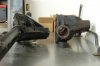
Below are a few pics from this morning. One shows the drastic difference in pinion height between the GM and the Ford pumpkins. From this photo its easy to see that rotating the C's may not be necessary. Depending on the ride height...you might even have to rotate them the other way!...
DSC_0021.JPG

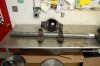
Here's a shot showing the new tube compared to a piece of the original tube. This is 3.000" OD x 1/2" wall (2" ID) T513A DOM steel. I bought 54" of it...just over $200 (OUCH!). As you can see, its slightly larger so I will need to lathe down the OD a few thousandths to fit into the pumpkin and also into the C's. The tubing that the factory uses is an odd-ball size so this was the closest I could get. When in doubt...go larger. You can always remove metal but its difficult to add it! I will also need to machine the ID (on the inboard ends), so I can install axle seals. They press into the tubes just outboard of the carrier caps to contain the oil inside the case...
DSC_0022.JPGDSC_0018.JPG
 

jakesz28

Well-Known Member
Messages
1,056
Location
Cabool MO
I would like to look at your rig before I get serious. But after I get back from Moab I plan to really looking at the SAS on mine. If every thing goes good out there I will have the time to build the axle first. But if things go pop it will speed up my cutting. I'm wondering if its really a good thought to start of with this trick. I want to stick with the 6 lug and common parts. But my past has showed me how easy a 44 can be broken. I know of some Dana 60 front axles around here. But that all most means 8 lug or more custom parts.
 

4speedfunk

Well-Known Member
Messages
4,250
Location
Tardville
No doubt the D60 is stronger. Its also nearly twice the weight, and nearly double the cost. I looked hard at it but, I decided the D60 is just plain overkill for what I use my truck for. When you consider the H3 is full-time 4wd and you'll be lugging that anchor around everywhere, I just couldn't justify the extra beef. Certainly if I were more hard-core I would consider it. But the AAM-7 has taught me to be very shy with the go-pedal, and I still drive that way. If I can't crawl it...I winch it. I don't back-up and hit it again over & over until I break something. Like a fat cheerleader...I realize that sometimes I must stand off to the side and watch all the hot, skinny girls (3000lb Jeeps) do the handstands, tumbling, and human pyramids.

I'll be the first to say a 5000lb. truck on 37" tires with 5.13s is technically beyond the D44's practical limit. But, I'm willing to take that gamble to reap the benefits of lower cost, lighter weight, less physical size, and perfect track width. If you stuff a D44 with modern aftermarket parts...set it up correctly...and know when to say when...its clearly a better choice for the use I'm looking for (expedition/camping/daily driving). Most of all...Dana 44's are so damn available. They're like cigarette butts! They are truly the small-block Chevy of axles...universal across 5 or 6 brands and 40+ years. Hard to argue with that track record.

If you're hell bent on running a D60...I would recommend the Recon route. Just call Dynatrac, order a high-pinion, pass-drop, Pro-rock 60 with a 6-lug bolt-pattern, 12mm studs, 5.13 gears, and a 67" WMS-WMS width. It will last forever and you'll probably never touch it again.
 

jakesz28

Well-Known Member
Messages
1,056
Location
Cabool MO
Yes but then I'm adding new rims and a different rear end. Which may not be to hard but I would want to keep the ABS and stability track working. With what CJ has done I think reusing the stock h3 rotors and calipers is the way to go. I'm not sure how the braking bias would be if I had to switch calipers. I would have some investigation to do on rotor width to see if I could use the h3 caliper on the standard 3/4 or 1 ton rotors. For me I have to keep down time to a minimum during the swap.
 

jakesz28

Well-Known Member
Messages
1,056
Location
Cabool MO
I have access to a couple GM Dana 60's. They are $700 to $1000 each but that is far from a custom one off part. Early 80's one ton diesel 4x4's.

I have to agree with CJ 44's are common and more robust then the factory axle.
 
Last edited:

06 H3

a.k.a. "The Jackal"
Messages
9,499
Location
Meridian, ID
Spoke to a JK guy with dynatrac 60s in the parking lot. The front alone was 13k. Throw the rear 60 price into the mix his axles are worth the entire JK stock

Idk if 13k is worth it lol
 

4speedfunk

Well-Known Member
Messages
4,250
Location
Tardville
The front alone was 13k

Holy cheese batman! I had no idea! I thought they were around $6K? In that case...I would have no problem cutting up a stock D60.

You could grab a CUCV D60 and just throw it in. It already comes with matching 4.56s, and the low-pin pumpkin is already on the passenger-side. That would be the cheapest option but, the 69" track width will be wider than a stock H3 (by about 2"). Another option is to do something similar to my Frankenstein D44 and junk-out a hi-pin Ford D60 to move the pumpkin to the pass side. Since you're stick-building it, you could narrow it to whatever width you wanted. Of course that means custom shafts, or at least mix-matching inner shafts to get the right width. I have no idea about the ABS mod but, I'm sure you could come up with something. It would be pricey....but nowhere close to $13K.
 

06 H3

a.k.a. "The Jackal"
Messages
9,499
Location
Meridian, ID
The rears are more like 6-7k.

I literally fell over at 13k. He was like but it's the competition series one! Trail ready series is cheaper but still expensive. They recently made an 80 for the front wonder how much that one is lol
 

Expendable

Well-Known Member
Messages
1,025
Location
Burbank, CA
at that cost of a 60, it might be cheaper to go 14 bolt FF up front converted to steer. and then shave it to make up for some ground clearance. and then you can go 14 bolt FF in the rear (if you wanna go crazy about, you convert it to steer as wheel then have four wheel steer). they make kits to shave the 14 bolt. they're expensive if someone knows what it is but some people don't know what it is.
 

MaxPF

AGNTSA
Messages
1,394
Location
The dark side of the globe
Dodge 60's are 2" narrower than the GM 60's. That's why I used a Dodge axle in my K5 - I didn't like the stock "front-wider-than-rear" thing. The late model 14bff I used turns out to be pretty much identical to the Dodge front 60 in width.

Yes, Dyna axles are retarded expensive. The price depends heavily on the options though. 13K sounds like he got every bell and whistle. AFAIK, 7K was more of a typical price, which is still stupidly expensive. If you get a used 60, plan on spending another grand getting it back to like-new condition. I opted to keep the stock brakes, which are large but VERY heavy. If you want lighter brakes, you can either go to thinner rotors (or hat-style rotors) and D44 calipers, or aftermarket. Aftermarket aluminum calipers will save the most weight, but they are $$$.
 

4speedfunk

Well-Known Member
Messages
4,250
Location
Tardville
Great info Max. That Dodge Dana60 front axle is a PS drop correct? If so...that would be the one to use in the H3.

Obviously it doesn't apply to everyone but, keeping factory brakes & ABS is big deal to us H3 guys. Of all the ill-conceived, poorly-designed, half-hearted systems choking the H3....I gotta give props to GM for getting the brakes RIGHT. Its one of the few things on these trucks that I would never change. I've got a few swap "kits" being produced right now that adapt the stock H3 brakes to the Dana44 axle. I'm sure something similar could be done on the Dana60 as well. I'll post up some THORnews on the brake kits when I pick them up from the machine shop next week. This isn't something I plan to make a bunch of...but several H3 guys and some Colorado/Canyon guys have expressed an interest in them. Its a cheap & easy way to keep all your electronic systems fully functional, plus you get the benefit of keeping your modern high-tech brakes. Here's a teaser pic...
DSC_0005.JPG
 
Top